

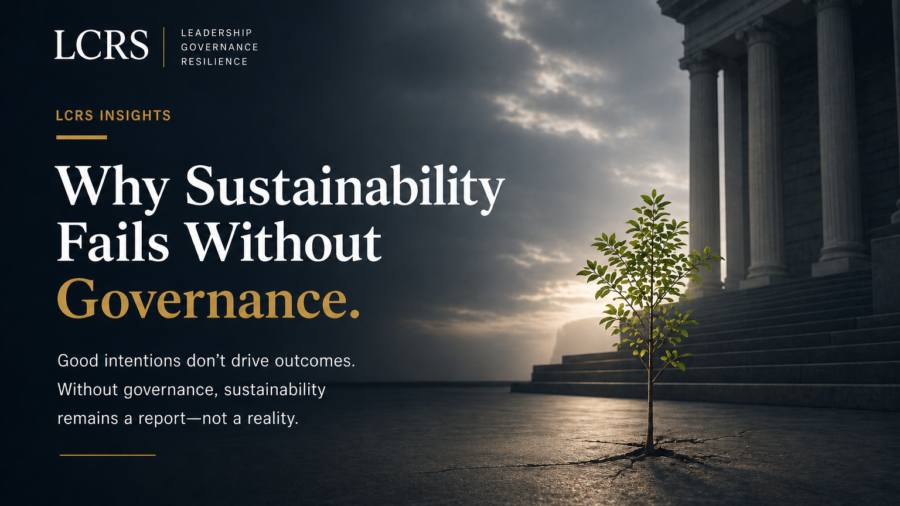
Sustainability Needs Governance — Not Just Visibility
Sustainability has become a strategic priority for organisations across sectors. Yet the belief that sustainability can succeed without deep governance integration is fundamentally flawed.
Visibility does not equal impact.
Despite improvements in reporting, growing regulatory demands, and increased public attention, many sustainability programmes still fail to influence how organisations actually operate.
The core issue is structural: sustainability is rarely embedded where real decisions are made.
As regulatory expectations and investor scrutiny intensify, this disconnect has become impossible to ignore.
The Positioning Problem
In many organisations, sustainability sits adjacent to the core business—not within it.
It is commonly framed as:
- Reporting
- Compliance
- Reputation management
These elements matter, but they are insufficient.
They do not determine how resources are allocated, how trade-offs are assessed, or how performance is measured. As a result, sustainability becomes visible but not decisive.
Where the Gap Appears
This misalignment becomes most evident during execution:
- Sustainability targets exist, but investment decisions do not reflect them.
- Environmental risks are identified, yet remain outside enterprise risk processes.
- Reporting improves, but underlying behaviours remain unchanged.
The organisation signals intent—but operates differently.
Governance: The Missing Mechanism
Governance is more than oversight.
It is the mechanism that turns priorities into decisions.
Governance determines:
- What gets considered
- What is prioritised
- What ultimately gets acted upon
Without governance integration, sustainability lacks authority.
Without authority, it lacks impact.
Reframing the Structural Gap
This challenge is not about the maturity of sustainability functions—it is about organisational design.
In many institutions, sustainability is positioned outside the systems that drive strategic and operational decisions. This reveals a deeper disconnect between governance, risk, and sustainability.
The LCRS Integrated Governance, Risk & Sustainability Architecture (IGRSA™) addresses this by embedding sustainability into governance and risk structures—ensuring it becomes a decision input, not merely a reporting output.
Without that integration, sustainability remains visible, but not influential.
Moving from Visibility to Influence
For sustainability to matter, it must shift:
From visibility → to influence
This requires:
- Board-level ownership
- Integration into risk and performance systems
- Alignment with strategic and operational decision-making
At this point, sustainability stops being an external obligation and becomes an internal driver.
What This Means for Leadership
For leadership, this is fundamentally a governance issue, not a sustainability issue.
It demands:
- Positioning sustainability within core governance structures—not as a side function
- Treating sustainability as a decision variable in strategy and capital allocation
- Integrating sustainability risks into enterprise risk frameworks
- Aligning performance metrics with sustainability outcomes, not just disclosures
Without these changes, sustainability will continue to communicate intent without shaping outcomes.
Conclusion
Sustainability does not fail due to lack of ambition.
It fails because it is structurally excluded from decision-making.
Without governance, sustainability remains narrative.
With governance, it becomes a driver of real decisions—and real outcomes.
About LCRS Insights
LCRS Insights provides thought leadership on governance, risk, sustainability, and organisational resilience.
This article is part of the LCRS Insights series exploring how organisations move from fragmented structures to integrated decision architectures.