
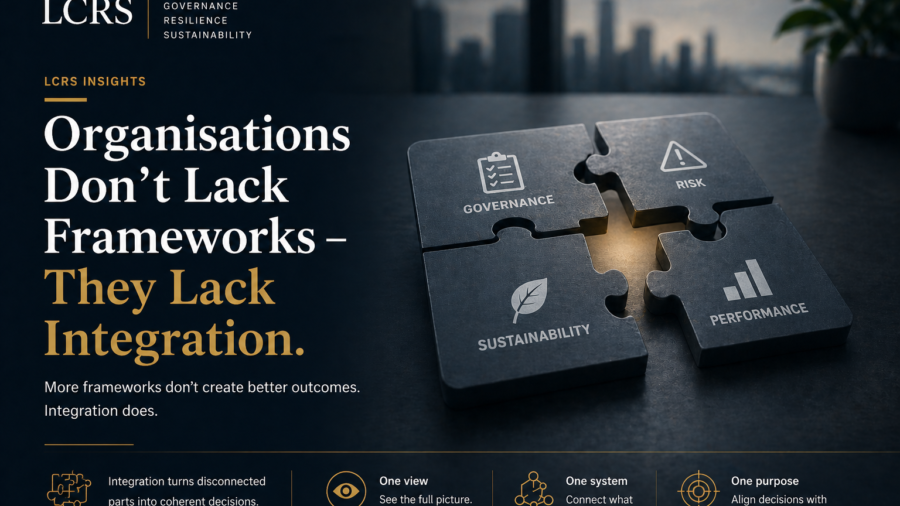
Modern organisations are not short of frameworks. In fact, they are saturated with them. The assumption that adding more frameworks improves performance no longer holds. Risk frameworks. ESG frameworks. Governance models. Performance systems. Each is designed to bring clarity, yet collectively they often generate complexity.
Under rising regulatory pressures and growing stakeholder scrutiny, fragmented systems introduce real organisational risk.
The Framework Paradox
Individually, frameworks provide structure.
Collectively, they create fragmentation.
Different functions adopt different models—each with its own methodology, metrics, and reporting cycles. Over time, these systems evolve independently, resulting in an organisation that is organised, but not aligned.
Where Fragmentation Becomes Visible
This misalignment produces tangible consequences:
- Multiple reports describing the same organisation in different ways
- Overlapping roles with unclear accountability
- Decisions made on partial or inconsistent insight
The organisation appears controlled, yet operates without coherence.
The Misdiagnosis
The common reaction is to introduce even more frameworks.
But expansion does not create integration—it magnifies fragmentation.
Real progress comes from alignment, not accumulation.
From Framework Proliferation to System Coherence
The core issue is not the quantity of frameworks, but the lack of coherence between them. This reflects a deeper structural disconnect across governance, risk, and sustainability.
The LCRS Integrated Governance, Risk & Sustainability Architecture (IGRSA™) addresses this by aligning these elements into a single decision system—ensuring frameworks operate as parts of a unified architecture, rather than isolated tools.
The goal is not to erase complexity, but to make it coherent and actionable.
A System-Level Perspective
The central question is no longer:
“Do we have the right frameworks?”
but rather:
“Do our frameworks operate as a system?”
Achieving this requires:
- Shared organisational objectives
- Connected data and insight
- Coherent and integrated governance
What This Means for Leadership
For senior leaders, the priority is not adding structure—it is reducing fragmentation.
This calls for:
- Aligning existing frameworks rather than expanding them
- Creating a unified view of risk, performance, and sustainability
- Eliminating duplication across reporting and governance processes
- Shifting governance from oversight to systemic integration
Without this shift, additional frameworks will only increase complexity rather than improve organisational outcomes.
Conclusion
Organisations do not need more frameworks.
They need fewer disconnections.
Without integration, frameworks multiply complexity.
With integration, they create clarity—and decisions that reflect reality.
About LCRS Insights
LCRS Insights provides thought leadership on governance, risk, sustainability, and organisational resilience.
This article forms part of the LCRS Insights series exploring how organisations move from fragmented systems to integrated decision architectures.