

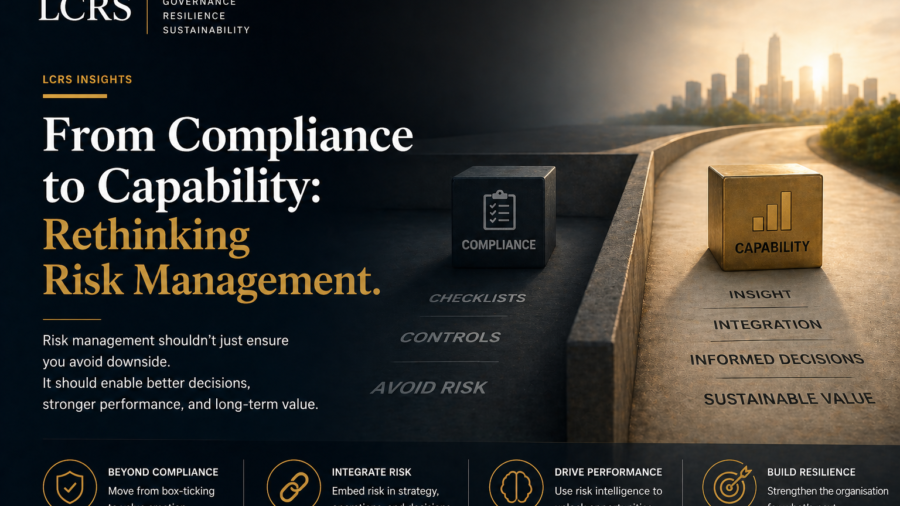
For many organisations, risk management remains anchored in compliance. But in increasingly complex operating environments, treating risk as a compliance exercise is no longer sufficient.
Policies are developed. Controls are implemented. Reports are produced.
These activities create structure — they do not necessarily create capability.
As organisations face growing volatility, regulatory scrutiny, and operational complexity, this limitation becomes more pronounced.
The Compliance Ceiling
Compliance establishes minimum standards. It ensures consistency and accountability.
But it does not guarantee:
- Effective decision-making
- Strategic alignment
- Organisational resilience
Beyond a certain point, increased compliance produces diminishing returns.
Where the Limitation Becomes Clear
The shortfall becomes visible in practice:
- Risk registers are maintained but rarely shape key decisions
- Controls are implemented but seldom evaluated for actual effectiveness
- Reporting increases while insight remains unchanged
Risk management becomes procedural, not functional.
Capability as the Next Stage
A more effective approach is to treat risk as a capability.
Capability is not defined by documents. It is defined by how consistently an organisation can:
- Interpret risk
- Integrate it into decisions
- Respond to uncertainty
What Capability Requires
Developing true risk capability requires:
- Leadership engagement, not delegation
- Integration with strategy and operations
- Continuous insight, not periodic reporting
This represents a shift from managing risk to operating with risk awareness.
Capability Within an Integrated System
Risk capability cannot be developed in isolation.
It depends on how risk interacts with governance, strategy, and operational systems.
The LCRS IGRSA™ framework positions risk within an integrated architecture, ensuring capability is embedded in decision-making structures—not confined to compliance processes.
Without integration, capability remains theoretical.
With integration, risk becomes a functional driver of organisational performance.
What This Means for Leadership
For leadership, the shift required is from compliance to capability.
This means:
- Moving beyond reporting to enhancing decision effectiveness
- Embedding risk into strategic and operational planning
- Investing in leadership understanding, not just frameworks
- Prioritising real-time insight over periodic reporting cycles
Organisations that fail to make this shift will meet requirements —
but struggle to navigate complexity.
Conclusion
The future of risk management is not compliance.
It is capability.
Organisations that do not make this shift will continue fulfilling requirements while struggling to make effective decisions in environments defined by uncertainty.
About LCRS Insights
LCRS Insights provides thought leadership on governance, risk, sustainability, and organisational resilience.
This article is part of the LCRS Insights series exploring how organisations move from fragmented structures to integrated decision architectures.