

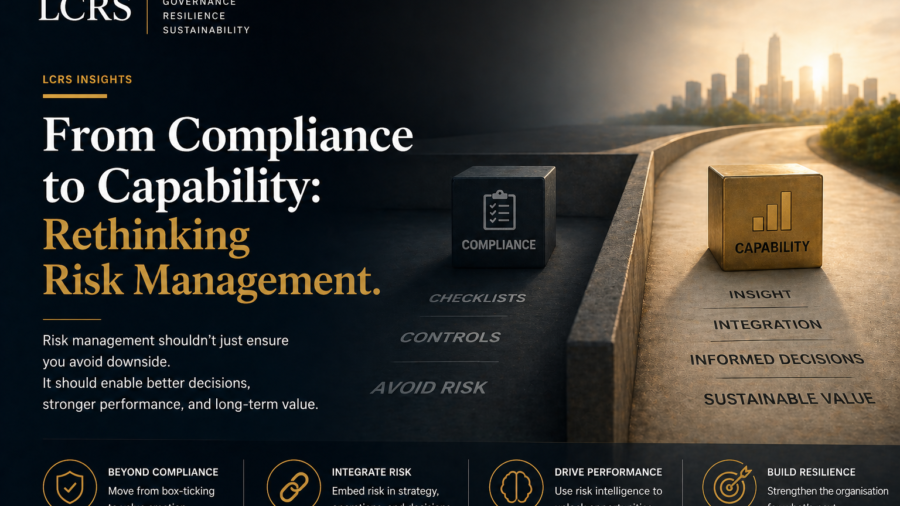
From Compliance to Capability Rethinking Risk Management

From Compliance to Capability: Rethinking Risk Management

For many organisations, risk management remains anchored in compliance. But in increasingly complex operating environments, treating risk as a compliance exercise is no longer sufficient.

Policies are developed. Controls are implemented. Reports are produced.
These activities create structure — they do not necessarily create capability.

As organisations face growing volatility, regulatory scrutiny, and operational complexity, this limitation becomes more pronounced.


The Compliance Ceiling

Compliance establishes minimum standards. It ensures consistency and accountability.
But it does not guarantee:

  • Effective decision-making
  • Strategic alignment
  • Organisational resilience

Beyond a certain point, increased compliance produces diminishing returns.


Where the Limitation Becomes Clear

The shortfall becomes visible in practice:

  • Risk registers are maintained but rarely shape key decisions
  • Controls are implemented but seldom evaluated for actual effectiveness
  • Reporting increases while insight remains unchanged

Risk management becomes procedural, not functional.


Capability as the Next Stage

A more effective approach is to treat risk as a capability.

Capability is not defined by documents. It is defined by how consistently an organisation can:

  • Interpret risk
  • Integrate it into decisions
  • Respond to uncertainty

What Capability Requires

Developing true risk capability requires:

  • Leadership engagement, not delegation
  • Integration with strategy and operations
  • Continuous insight, not periodic reporting

This represents a shift from managing risk to operating with risk awareness.


Capability Within an Integrated System

Risk capability cannot be developed in isolation.
It depends on how risk interacts with governance, strategy, and operational systems.

The LCRS IGRSA™ framework positions risk within an integrated architecture, ensuring capability is embedded in decision-making structures—not confined to compliance processes.

Without integration, capability remains theoretical.
With integration, risk becomes a functional driver of organisational performance.


What This Means for Leadership

For leadership, the shift required is from compliance to capability.

This means:

  • Moving beyond reporting to enhancing decision effectiveness
  • Embedding risk into strategic and operational planning
  • Investing in leadership understanding, not just frameworks
  • Prioritising real-time insight over periodic reporting cycles

Organisations that fail to make this shift will meet requirements —
but struggle to navigate complexity.


Conclusion

The future of risk management is not compliance.
It is capability.

Organisations that do not make this shift will continue fulfilling requirements while struggling to make effective decisions in environments defined by uncertainty.


About LCRS Insights

LCRS Insights provides thought leadership on governance, risk, sustainability, and organisational resilience.
This article is part of the LCRS Insights series exploring how organisations move from fragmented structures to integrated decision architectures.
The Problem Is Not Risk - It’s Disconnection

The Problem Is Not Risk — It’s Disconnection

Most organisations believe their challenge is managing risk. They assume that more structure automatically delivers better control.
It doesn’t.

The real challenge is that risk, governance, and sustainability systems do not operate as a single, integrated decision architecture.
Risk frameworks exist. Governance structures are established. Sustainability initiatives are defined. Yet these elements rarely function as a unified system shaping how decisions are made.

The issue is not capability — it is connection.


The Structural Illusion

In a world of increasing regulatory scrutiny and stakeholder expectations, this structural gap becomes more visible and more consequential.

Modern organisations appear structurally advanced: policies documented, controls implemented, reporting systems mature.
This creates the appearance of control.

But control is not defined by structure — it is defined by how effectively information influences decisions.

In practice, risk is reviewed, escalated, and recorded — yet often disconnected from the moment where decisions are actually made.
The belief that adding structure equals better control remains deeply embedded, but in reality, it often produces fragmentation.


Where the System Breaks

This disconnection is not theoretical. It is operational.

It shows up in predictable ways:

  • Risk is escalated but diluted before reaching strategic decisions
  • Sustainability commitments are reported externally but disconnected from operational priorities
  • Governance structures oversee performance but lack real-time visibility of exposure

What appears as structure begins to function as separation.

This is where organisations become most vulnerable — not due to lack of oversight, but due to lack of coherence.


The Misdiagnosis

The typical response is to introduce more frameworks:
more reporting, more controls, more structure.

This compounds the problem.

The issue is not the absence of frameworks; it is the absence of integration between them.

Organisations do not lack risk management capability.
They lack an integrated decision architecture connecting governance, risk, sustainability, and performance.


Reframing Risk: From Function to System Capability

Risk must evolve beyond a standalone function.
It must become a system capability, embedded in how the organisation thinks, decides, and acts.

This requires a shift from risk management to risk intelligence:

  • Not more data — but more relevant insight
  • Not periodic reporting — but real-time influence
  • Not escalation — but integration into decision-making

Without this shift, risk remains descriptive, never decisive.


The Role of Integrated Architecture (IGRSA™)

This challenge is fundamentally structural.
It reflects how organisations design the relationships between governance, risk, and sustainability.

The LCRS Integrated Governance, Risk & Sustainability Architecture (IGRSA™) addresses this by ensuring these domains operate as a unified system.

Rather than adding new frameworks, it enables:

  • Alignment of governance structures with sustainability and risk inputs
  • Integration of risk into strategic and capital allocation decisions
  • Embedding sustainability within operational and performance systems

The objective is not more structure — it is system coherence.


What This Means for Leadership

For senior leaders, this is not a technical adjustment — it is a structural redesign.

It requires:

  • Reframing risk from a reporting function to a core decision input
  • Redesigning governance forums to shape decisions, not just review exposure
  • Integrating sustainability into operational and investment trade-offs
  • Creating a single, coherent view of risk, performance, and long-term value

Without this shift, leadership teams will continue making decisions with incomplete visibility — regardless of how sophisticated their frameworks appear.

The consequence is not merely inefficiency.
It is misinformed decision-making at scale.


The Cost of Inaction

Organisations that fail to address structural disconnection will face:

  • Strategic decisions misaligned with real risk exposure
  • Sustainability commitments detached from operational reality
  • Increased complexity without improved control
  • A false sense of security created by governance structures

Over time, this creates systemic vulnerability.


Conclusion

The problem is not risk.
The problem is that risk, governance, and sustainability are not designed to operate as a single system.

Organisations do not fail due to lack of frameworks —
they fail due to the illusion that those frameworks are working.


About LCRS Insights

LCRS Insights provides thought leadership on governance, risk, sustainability, and organisational resilience.
This article is part of the LCRS Insights series exploring how organisations move from fragmented structures to integrated decision architectures.
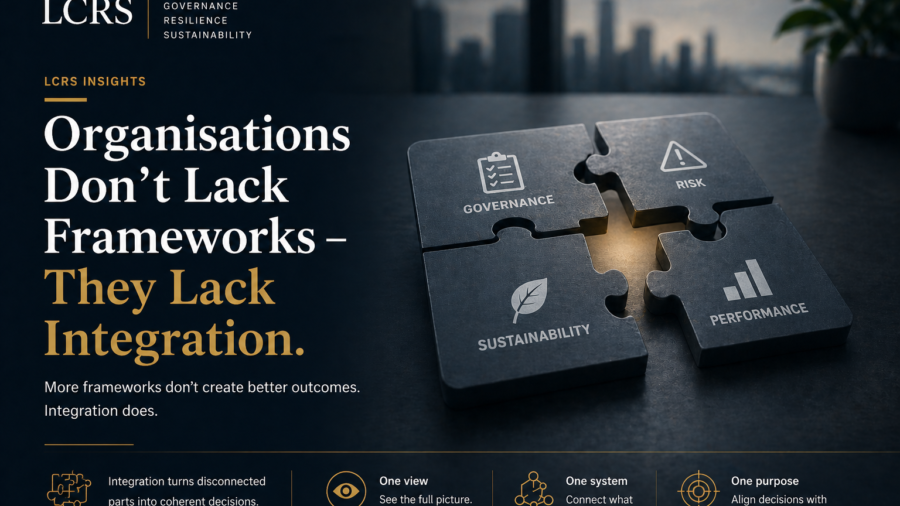
Organisations Don’t Lack Frameworks - They Lack Integration

Organisations Don’t Lack Frameworks — They Lack Integration

Modern organisations are not short of frameworks. In fact, they are saturated with them. The assumption that adding more frameworks improves performance no longer holds. Risk frameworks. ESG frameworks. Governance models. Performance systems. Each is designed to bring clarity, yet collectively they often generate complexity.

Under rising regulatory pressures and growing stakeholder scrutiny, fragmented systems introduce real organisational risk.


The Framework Paradox

Individually, frameworks provide structure.
Collectively, they create fragmentation.

Different functions adopt different models—each with its own methodology, metrics, and reporting cycles. Over time, these systems evolve independently, resulting in an organisation that is organised, but not aligned.


Where Fragmentation Becomes Visible

This misalignment produces tangible consequences:

  • Multiple reports describing the same organisation in different ways
  • Overlapping roles with unclear accountability
  • Decisions made on partial or inconsistent insight

The organisation appears controlled, yet operates without coherence.


The Misdiagnosis

The common reaction is to introduce even more frameworks.
But expansion does not create integration—it magnifies fragmentation.

Real progress comes from alignment, not accumulation.


From Framework Proliferation to System Coherence

The core issue is not the quantity of frameworks, but the lack of coherence between them. This reflects a deeper structural disconnect across governance, risk, and sustainability.

The LCRS Integrated Governance, Risk & Sustainability Architecture (IGRSA™) addresses this by aligning these elements into a single decision system—ensuring frameworks operate as parts of a unified architecture, rather than isolated tools.

The goal is not to erase complexity, but to make it coherent and actionable.


A System-Level Perspective

The central question is no longer:

“Do we have the right frameworks?”
but rather:
“Do our frameworks operate as a system?”

Achieving this requires:

  • Shared organisational objectives
  • Connected data and insight
  • Coherent and integrated governance

What This Means for Leadership

For senior leaders, the priority is not adding structure—it is reducing fragmentation.

This calls for:

  • Aligning existing frameworks rather than expanding them
  • Creating a unified view of risk, performance, and sustainability
  • Eliminating duplication across reporting and governance processes
  • Shifting governance from oversight to systemic integration

Without this shift, additional frameworks will only increase complexity rather than improve organisational outcomes.


Conclusion

Organisations do not need more frameworks.
They need fewer disconnections.

Without integration, frameworks multiply complexity.
With integration, they create clarity—and decisions that reflect reality.


About LCRS Insights

LCRS Insights provides thought leadership on governance, risk, sustainability, and organisational resilience.
This article forms part of the LCRS Insights series exploring how organisations move from fragmented systems to integrated decision architectures.

Why Sustainability Fails Without Governance

Why-Sustainability-Fails-Without-Governance

Sustainability Needs Governance — Not Just Visibility

Sustainability has become a strategic priority for organisations across sectors. Yet the belief that sustainability can succeed without deep governance integration is fundamentally flawed.

Visibility does not equal impact.
Despite improvements in reporting, growing regulatory demands, and increased public attention, many sustainability programmes still fail to influence how organisations actually operate.

The core issue is structural: sustainability is rarely embedded where real decisions are made.
As regulatory expectations and investor scrutiny intensify, this disconnect has become impossible to ignore.


The Positioning Problem

In many organisations, sustainability sits adjacent to the core business—not within it.

It is commonly framed as:

  • Reporting
  • Compliance
  • Reputation management

These elements matter, but they are insufficient.
They do not determine how resources are allocated, how trade-offs are assessed, or how performance is measured. As a result, sustainability becomes visible but not decisive.


Where the Gap Appears

This misalignment becomes most evident during execution:

  • Sustainability targets exist, but investment decisions do not reflect them.
  • Environmental risks are identified, yet remain outside enterprise risk processes.
  • Reporting improves, but underlying behaviours remain unchanged.

The organisation signals intent—but operates differently.


Governance: The Missing Mechanism

Governance is more than oversight.
It is the mechanism that turns priorities into decisions.

Governance determines:

  • What gets considered
  • What is prioritised
  • What ultimately gets acted upon

Without governance integration, sustainability lacks authority.
Without authority, it lacks impact.


Reframing the Structural Gap

This challenge is not about the maturity of sustainability functions—it is about organisational design.

In many institutions, sustainability is positioned outside the systems that drive strategic and operational decisions. This reveals a deeper disconnect between governance, risk, and sustainability.

The LCRS Integrated Governance, Risk & Sustainability Architecture (IGRSA™) addresses this by embedding sustainability into governance and risk structures—ensuring it becomes a decision input, not merely a reporting output.

Without that integration, sustainability remains visible, but not influential.


Moving from Visibility to Influence

For sustainability to matter, it must shift:

From visibility → to influence

This requires:

  • Board-level ownership
  • Integration into risk and performance systems
  • Alignment with strategic and operational decision-making

At this point, sustainability stops being an external obligation and becomes an internal driver.


What This Means for Leadership

For leadership, this is fundamentally a governance issue, not a sustainability issue.

It demands:

  • Positioning sustainability within core governance structures—not as a side function
  • Treating sustainability as a decision variable in strategy and capital allocation
  • Integrating sustainability risks into enterprise risk frameworks
  • Aligning performance metrics with sustainability outcomes, not just disclosures

Without these changes, sustainability will continue to communicate intent without shaping outcomes.


Conclusion

Sustainability does not fail due to lack of ambition.
It fails because it is structurally excluded from decision-making.

Without governance, sustainability remains narrative.
With governance, it becomes a driver of real decisions—and real outcomes.


About LCRS Insights

LCRS Insights provides thought leadership on governance, risk, sustainability, and organisational resilience.
This article is part of the LCRS Insights series exploring how organisations move from fragmented structures to integrated decision architectures.