

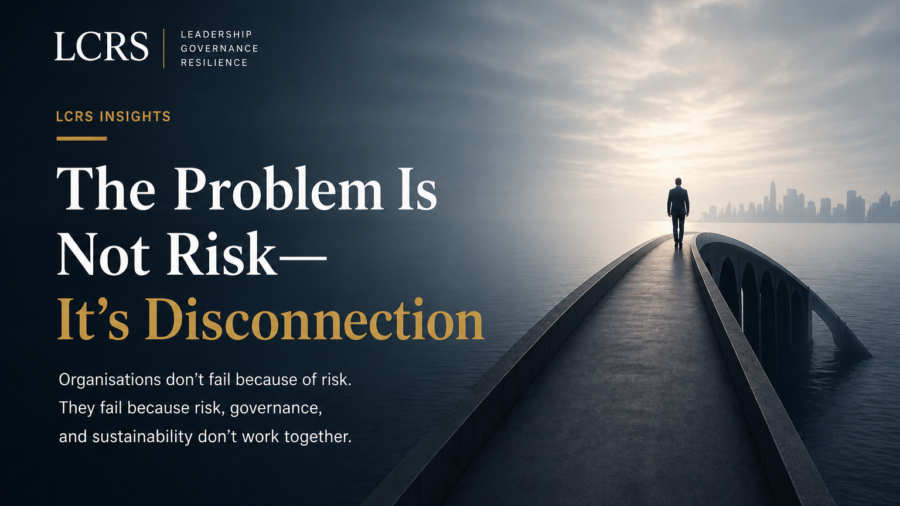
Most organisations believe their challenge is managing risk. They assume that more structure automatically delivers better control.
It doesn’t.
The real challenge is that risk, governance, and sustainability systems do not operate as a single, integrated decision architecture.
Risk frameworks exist. Governance structures are established. Sustainability initiatives are defined. Yet these elements rarely function as a unified system shaping how decisions are made.
The issue is not capability — it is connection.
The Structural Illusion
In a world of increasing regulatory scrutiny and stakeholder expectations, this structural gap becomes more visible and more consequential.
Modern organisations appear structurally advanced: policies documented, controls implemented, reporting systems mature.
This creates the appearance of control.
But control is not defined by structure — it is defined by how effectively information influences decisions.
In practice, risk is reviewed, escalated, and recorded — yet often disconnected from the moment where decisions are actually made.
The belief that adding structure equals better control remains deeply embedded, but in reality, it often produces fragmentation.
Where the System Breaks
This disconnection is not theoretical. It is operational.
It shows up in predictable ways:
- Risk is escalated but diluted before reaching strategic decisions
- Sustainability commitments are reported externally but disconnected from operational priorities
- Governance structures oversee performance but lack real-time visibility of exposure
What appears as structure begins to function as separation.
This is where organisations become most vulnerable — not due to lack of oversight, but due to lack of coherence.
The Misdiagnosis
The typical response is to introduce more frameworks:
more reporting, more controls, more structure.
This compounds the problem.
The issue is not the absence of frameworks; it is the absence of integration between them.
Organisations do not lack risk management capability.
They lack an integrated decision architecture connecting governance, risk, sustainability, and performance.
Reframing Risk: From Function to System Capability
Risk must evolve beyond a standalone function.
It must become a system capability, embedded in how the organisation thinks, decides, and acts.
This requires a shift from risk management to risk intelligence:
- Not more data — but more relevant insight
- Not periodic reporting — but real-time influence
- Not escalation — but integration into decision-making
Without this shift, risk remains descriptive, never decisive.
The Role of Integrated Architecture (IGRSA™)
This challenge is fundamentally structural.
It reflects how organisations design the relationships between governance, risk, and sustainability.
The LCRS Integrated Governance, Risk & Sustainability Architecture (IGRSA™) addresses this by ensuring these domains operate as a unified system.
Rather than adding new frameworks, it enables:
- Alignment of governance structures with sustainability and risk inputs
- Integration of risk into strategic and capital allocation decisions
- Embedding sustainability within operational and performance systems
The objective is not more structure — it is system coherence.
What This Means for Leadership
For senior leaders, this is not a technical adjustment — it is a structural redesign.
It requires:
- Reframing risk from a reporting function to a core decision input
- Redesigning governance forums to shape decisions, not just review exposure
- Integrating sustainability into operational and investment trade-offs
- Creating a single, coherent view of risk, performance, and long-term value
Without this shift, leadership teams will continue making decisions with incomplete visibility — regardless of how sophisticated their frameworks appear.
The consequence is not merely inefficiency.
It is misinformed decision-making at scale.
The Cost of Inaction
Organisations that fail to address structural disconnection will face:
- Strategic decisions misaligned with real risk exposure
- Sustainability commitments detached from operational reality
- Increased complexity without improved control
- A false sense of security created by governance structures
Over time, this creates systemic vulnerability.
Conclusion
The problem is not risk.
The problem is that risk, governance, and sustainability are not designed to operate as a single system.
Organisations do not fail due to lack of frameworks —
they fail due to the illusion that those frameworks are working.
About LCRS Insights
LCRS Insights provides thought leadership on governance, risk, sustainability, and organisational resilience.
This article is part of the LCRS Insights series exploring how organisations move from fragmented structures to integrated decision architectures.